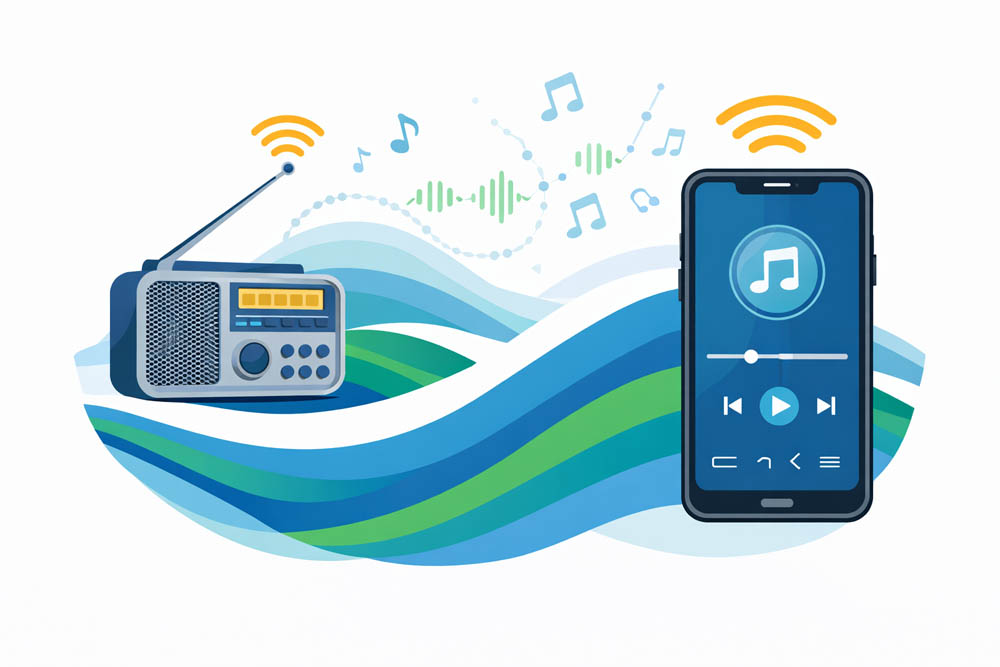
The way people consume audio content is undergoing one of the most dramatic transformations in broadcast history. For nearly a century, terrestrial radio was the unchallenged king of audio broadcasting. Today, that crown is being contested by a fast-growing, technology-driven challenger: audio streaming. Yet this is not simply a story of old versus new. It is a story about complementary technologies, expanded reach, and the strategic imperative for every broadcaster to understand both worlds and embrace them together.
Terrestrial radio refers to the broadcast of audio signals over the airwaves using AM or FM frequencies, reaching listeners through radio receivers. At its core, a terrestrial station captures audio at the studio, processes it through audio processors and compressors for consistent sound levels, and modulates the signal onto a carrier frequency. That signal is then transmitted from an antenna tower at a power level regulated by each country's broadcasting authority, propagating through the air as radio waves until it reaches a listener's receiver, where it is demodulated back into audio. Beyond analog, the industry has developed digital terrestrial standards including DAB, IBOC, ISDB-TSB, and DRM, giving broadcasters richer metadata and improved signal quality but still within geographic boundaries.
Audio streaming, by contrast, is the real-time delivery of audio content over the internet. Unlike downloading, streaming allows a listener to tune in instantly without storing files on their device. The pipeline begins at the audio source, a DJ, a live event, or a music playlist, which is then encoded and compressed using codecs such as AAC, MP3, Ogg Vorbis, or Opus, expressed in kilobits per second. The higher the bitrate, the better the audio quality, though this demands greater bandwidth. The encoded audio is then pushed to a streaming server or Content Delivery Network, which handles server management, redundancy, analytics, and media player delivery. Modern streaming uses protocols like HLS, which breaks audio into small sequential segments for reliable delivery. The listener's device then decodes the stream and plays the content instantly, whether on a smartphone, computer, or smart speaker.
The differences between these two technologies are both technical and experiential. Terrestrial radio is limited by tower radius, susceptible to static and interference, and accessible only through a radio receiver. Streaming delivers a consistent digital signal worldwide, works on any internet-connected device, and supports both live and on-demand content. Traditional radio listenership relies on estimated ratings, while streaming provides real-time granular data on who is listening, for how long, on what device, and from where. This data advantage alone represents a fundamental shift in how broadcasters and advertisers operate.
Terrestrial radio, however, is far from obsolete. It remains a powerful and trusted medium. It functions without any internet infrastructure, making it indispensable in areas with limited connectivity and absolutely critical during emergencies and natural disasters. It commands massive local audiences in vehicles, homes, and public spaces. Local stations carry community identity, trusted voices, and cultural significance that streaming platforms have yet to replicate on a local level. These strengths are real and must be respected but they are no longer sufficient on their own.
Audio streaming holds decisive advantages that are reshaping the entire broadcasting industry. The most immediate is reach. A station that previously served only listeners within range of its transmitter can, through streaming, attract audiences across the country and around the world, diaspora communities, travelling professionals, and international listeners who share cultural or linguistic ties to that station's content. Streaming also offers on-demand flexibility, allowing listeners to replay programmes, access curated playlists, and choose content on their own schedule. Digital audio now reaches 76% of Americans aged 12 and above, and digital listeners consume nearly five hours of audio every day. Meanwhile, the share of time spent with AM and FM radio has declined by 24% since 2015.
From an advertising perspective, streaming offers capabilities that terrestrial radio simply cannot match. Where traditional radio relies on audience estimates, streaming delivers precise demographics, location data, device usage, and listening behaviour enabling advertisers to target their messages with extraordinary accuracy. Streaming audio platforms also offer dynamic audio advertising, which uses location, weather, and listening genre to generate millions of ad variations tailored to individual listeners. Ad breaks on streaming are significantly shorter, often featuring just one ad per break compared to traditional radio's longer commercial blocks. The Audio Completion Rate, the percentage of ads played to the end benchmarks at 91% on platforms like Spotify, a metric that simply does not exist in terrestrial measurement. Advertisers gain full visibility into impressions, reach, frequency, clicks, and engagement in real time.
Given all of this, the most important strategic question for any terrestrial broadcaster today is not whether to stream, it is why they have not already done so. Simulcasting, the practice of broadcasting the same content simultaneously on both terrestrial frequencies and the internet, is the technical bridge that makes this possible. It saves broadcasters time and money, expands audience reach without creating new content, and opens digital revenue streams alongside existing terrestrial income. Technically, the process involves routing the studio audio output into a streaming encoder, which compresses the signal and pushes it to a CDN for real-time global distribution with minimal latency and professional-grade reliability.
Loyal terrestrial audiences are already seeking their favourite stations online. On average, AM and FM simulcast streaming generates approximately 2.5 hours per day of online listening, proving that existing audiences will actively extend their listening through digital platforms when given the opportunity. A station that streams live gives its audience the freedom to tune in from the car on FM, at home on a smart speaker, or at work on a laptop without ever losing them to a competitor. Stations can also dynamically insert different advertisements into their online stream, allowing advertisers to combine the precision of digital targeting with the trust of an established local radio brand. This creates an entirely new and highly valuable revenue layer.
For stations committing to live streaming, the infrastructure requirements are straightforward. A professional-grade streaming encoder is essential enterprise hardware, not consumer or repurposed office equipment. HLS is the modern standard protocol for reliable, high-quality delivery. A dependable CDN partnership is critical, as broadcasting and netcasting are 24/7 operations, and any downtime directly translates to lost audience and lost revenue. A streaming bitrate of 128 kbps AAC is the benchmark for broadcast-quality online audio. Proper metadata integration ensures that programme and song titles display correctly to online listeners, maintaining the professional standard audiences expect.
Terrestrial radio remains a powerful, trusted, and deeply local medium. It is irreplaceable during emergencies, indispensable in vehicles, and deeply woven into the cultural identity of communities around the world. But the modern listener is mobile, global, and expects to access their favourite content on any device, at any time, from anywhere. Audio streaming is not the enemy of terrestrial radio, it is its most powerful ally. Stations that understand this and act on it will not merely survive the digital transformation of broadcasting. They will lead it. The signal has always been the soul of radio. It is time to set that soul free beyond the towers, beyond the borders, and beyond the airwaves.